Complex Behavioural Needs
Autism Spectrum Disorder
Supporting a participant with autism spectrum disorder and complex behavioural needs requires consistency, clinical understanding, and staff who engage — not supervise. Nurse Aid Australia provides specialist SIL for ASD participants with high support needs.
What we mean by ASD with complex support needs
Autism spectrum disorder in a SIL context
Autism spectrum disorder is a neurodevelopmental condition affecting how a person communicates, interacts, and experiences the world. In an NDIS SIL context, participants with ASD and complex support needs typically present with behaviours of concern, sensory sensitivities, communication differences, and a high need for predictable, consistent environments and support workers.
- Behaviours of concern requiring structured, individualised behaviour support responses
- Sensory sensitivities — to sound, light, touch, smell, or environment — affecting daily functioning
- Communication differences — including non-verbal communication, AAC use, and echolalia
- Rigid routines and high sensitivity to change — disruption can cause significant distress
- Social interaction differences requiring patient, adapted support approaches
- Co-occurring conditions — intellectual disability, ADHD, anxiety, or epilepsy alongside ASD
- High sensitivity to staff changes — consistency in the support team is not a preference, it is a clinical requirement
What This Cohort Requires
Support capability for complex ASD support needs
Participants with ASD and complex support needs require specific capability — not general disability experience. These are the non-negotiables.
Behaviour support integration
Documented positive behaviour support plans developed with a behaviour support practitioner and implemented consistently across all staff.
Consistent staffing
For ASD participants, staff consistency is a clinical requirement — not a preference. Disruption to the support team directly impacts behaviour and wellbeing.
Structured, predictable routines
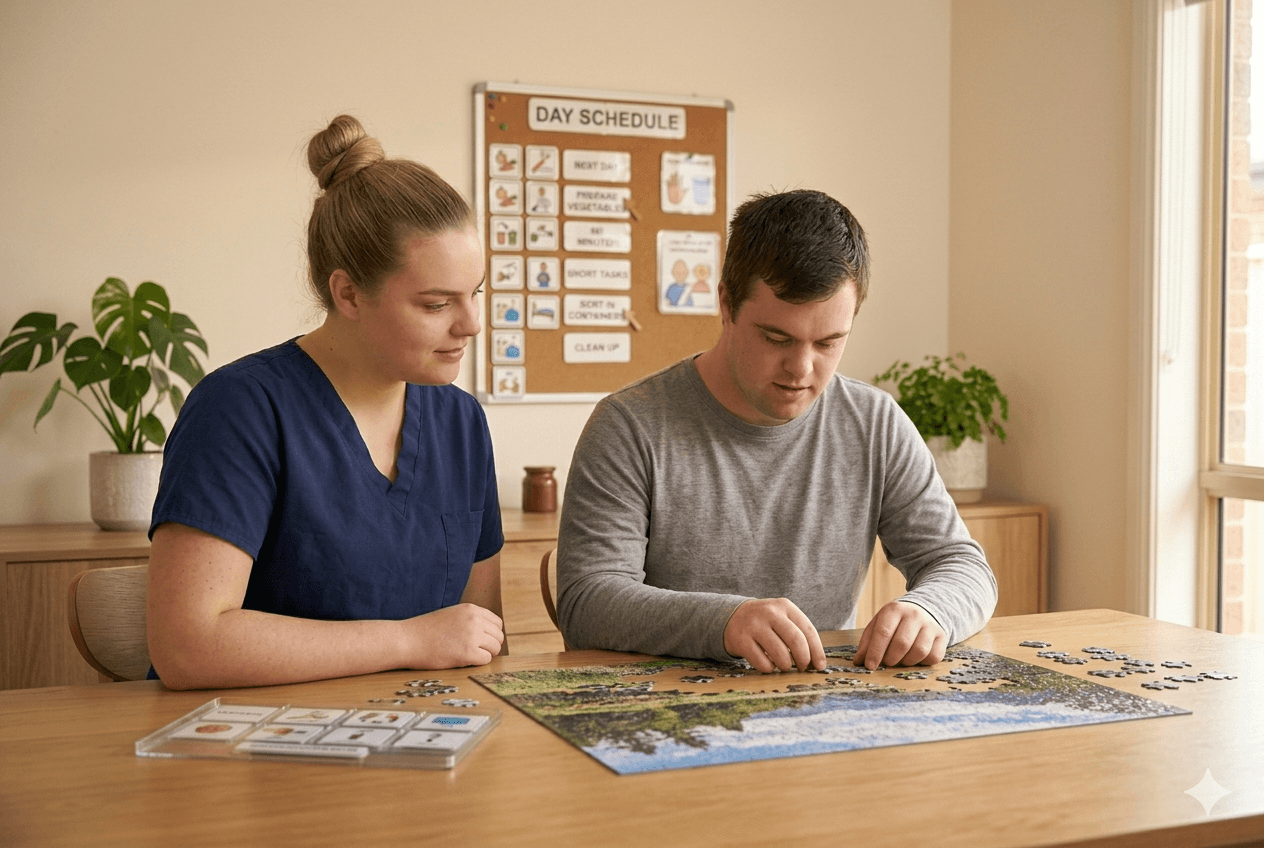
Predictability reduces anxiety and supports daily functioning. Routines are built around the participant — not the house schedule.
Communication-adapted support
Staff trained in AAC, PECS, visual supports, and the participant's specific communication profile from day one.
Sensory-considered environments
Support environments and daily routines adapted to each participant's sensory profile.
Active support — not passive supervision
Staff who engage, prompt, and work alongside the participant toward their goals — not workers who watch from a distance.
Our Approach
How NAA supports participants with autism spectrum disorder
✏️ Client to provide: specific approach to ASD support — active support model, behaviour support integration, sensory considerations, communication approach, rostering for consistency
Staff Capability
Clinical capability for complex ASD support
✏️ Client to confirm: ASD-specific training, behaviour support practitioner involvement, AAC and communication training, rostering approach for staff consistency
From A Service Coordinator
From my experience, their carers show genuine compassion and go above and beyond to understand each participant's individual needs. The team is highly professional — clear communication, strong data collection, and thorough attention to detail. I would highly recommend NAA as a SIL and care provider.
Frequently Asked
Questions coordinators ask about ASD support
If your question is not here, call us directly. We answer during business hours and return all messages the same day.
✏️ Participant story link — populate once /evidence page is published